Have you ever paused to think about the rhythm of our calendar, and how sometimes, a year just feels a little bit different? We live by a calendar that, most of the time, gracefully aligns with the Earth’s journey around the sun. But every so often, a special adjustment is needed. That brings us to our core question today: Is February 2026 a Leap Year? Let’s dive deep into the fascinating world of leap years and uncover the answer.

Understanding the Basics of a Leap Year
To truly answer whether February 2026 will have an extra day, we first need to grasp what a leap year actually is and why it’s so crucial for our timekeeping. A leap year is a calendar year containing an additional day compared to a common year. This extra day, known as a leap day, is added to February, extending it to 29 days instead of the usual 28.
Why Do We Need Leap Years?
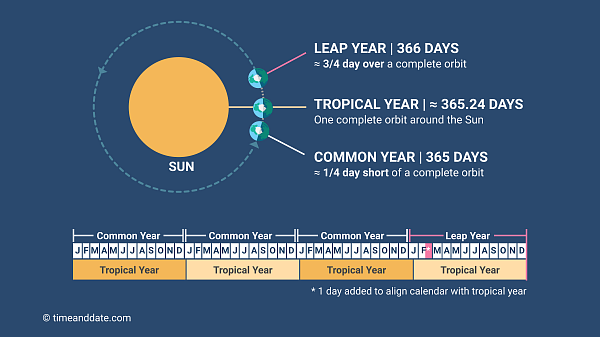
The fundamental reason for leap years lies in the discrepancy between our civil calendar and the Earth’s orbit. Our planet doesn’t take exactly 365 days to circle the sun. Instead, it takes approximately 365.2422 days, which we call a tropical year or solar year. That extra quarter of a day might seem small, but over time, it adds up. If we ignored it, our calendar would slowly drift out of sync with the seasons. Imagine celebrating summer solstice in December! Leap years are our elegant solution to keep things aligned.
The Historical Roots: Julian and Gregorian Calendars
The concept of adding an extra day isn’t new. Ancient civilizations grappled with similar problems. The Romans, under Julius Caesar, introduced the Julian calendar in 45 BCE. This calendar simply added a leap day every four years. While a good start, it was slightly inaccurate, overcorrecting by about 11 minutes per year. By the 16th century, this accumulated error had pushed the calendar off by about 10 days, affecting religious observances like Easter.
Pope Gregory XIII introduced the Gregorian calendar in 1582, which is the system most of the world uses today. This refined calendar corrected the Julian system’s error, establishing the rules we follow for determining leap years. This historical context is vital for understanding the precision required in modern calendar keeping.
The Gregorian Calendar Rules for Determining a Leap Year
The Gregorian calendar’s rules are quite specific, designed to maintain accuracy over centuries. It’s not just a simple ‘every four years’ anymore, although that’s the primary rule. There are important exceptions.
The Primary Rule: Divisibility by Four
The most commonly known rule states that a year is a leap year if it is divisible by 4. For example, 2020 was a leap year because 2020 ÷ 4 = 505. This rule accounts for the majority of leap years and ensures that the calendar stays roughly in line with the Earth’s orbit.
The Century Rule: Divisibility by 100
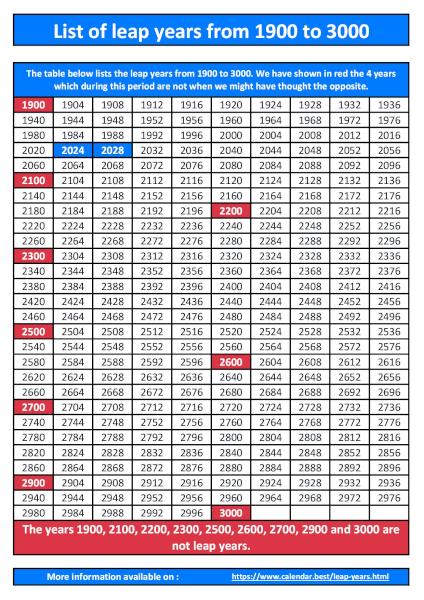
Here’s where it gets a little more complex. If a year is divisible by 100 (e.g., 1700, 1800, 1900), it is generally NOT a leap year. These are called common century years. This rule was introduced to correct the slight overcorrection of the Julian calendar’s simple four-year cycle. Without this rule, the calendar would still gain a day every 400 years.
The Exception to the Century Rule: Divisibility by 400
But wait, there’s an exception to the exception! If a century year is also divisible by 400, then it IS a leap year. Examples include 1600 and 2000. This refinement ensures the calendar remains remarkably accurate. It’s this intricate balance of rules that keeps our calendar from drifting significantly over long periods. These adjustments are a testament to human ingenuity in tracking celestial movements.
Applying the Rules: Is February 2026 a Leap Year?
Now that we understand the rules, let’s apply them to our specific year: 2026. This is the moment of truth for our primary question: Is February 2026 a Leap Year?
Step-by-Step Calculation for 2026
1. Is 2026 divisible by 4? Let’s do the math: 2026 ÷ 4 = 506.5. Since it’s not a whole number, 2026 is NOT perfectly divisible by 4.
2. Do we need to consider the century rules? No, because 2026 is not a century year (it’s not divisible by 100).
Based on these calculations, we can confidently conclude that 2026 is NOT a leap year. Therefore, February 2026 will have 28 days, just like a common year.
What About Surrounding Years?
To put this in perspective, let’s look at the years around 2026. The most recent leap year was 2024. The next one will be 2028. This follows the standard four-year cycle because neither 2024, 2028, nor any intervening year is a century year that fails the divisibility-by-400 test.
Here’s a quick look at recent and upcoming years and their leap year status:
| Year | Divisible by 4? | Divisible by 100? | Divisible by 400? | Leap Year Status | Days in February |
|---|---|---|---|---|---|
| 2020 | Yes | No | N/A | Leap Year | 29 |
| 2021 | No | No | N/A | Common Year | 28 |
| 2022 | No | No | N/A | Common Year | 28 |
| 2023 | No | No | N/A | Common Year | 28 |
| 2024 | Yes | No | N/A | Leap Year | 29 |
| 2026 | No | No | N/A | Common Year | 28 |
| 2028 | Yes | No | N/A | Leap Year | 29 |
| 2100 | Yes | Yes | No | Common Year | 28 |
The Astronomical Significance of Leap Years
Beyond simply keeping our daily lives organized, leap years have a profound connection to astronomy and the mechanics of our solar system. The Earth’s orbit is not a perfect 365 days; it’s intricately tied to the fundamental physical principles governing celestial bodies. Understanding this connection elevates leap years from a mere calendar adjustment to a cosmic balancing act.
The Earth’s Orbital Period
The Earth actually takes about 365 days, 5 hours, 48 minutes, and 45 seconds to complete one orbit around the sun. This is the precise length of a tropical year. Our 365-day calendar year falls short by nearly six hours each year. If we didn’t account for this, the accumulated difference would shift the seasons. Farmers relying on seasonal cues, and astronomers tracking celestial events, would face increasing inaccuracies.
Connecting to Solstices and Equinoxes
Leap years are essential for keeping the calendar synchronized with key astronomical events like the solstices (summer and winter) and equinoxes (spring and autumn). These events mark the precise moments when the Earth’s axis is tilted most towards or away from the sun, or when it’s neither tilted away nor towards the sun. If our calendar drifted, these fixed astronomical points would move earlier and earlier in the year according to our dates, causing confusion and practical problems.
The Impact and Quirks of a Leap Day
While the primary purpose of a leap day is purely calendrical, it has developed some interesting social and cultural implications. A February 29th birthday, for example, is quite unique.
Leap Year Birthdays (Leaplings)
People born on February 29th are sometimes called “leaplings” or “leapers.” They only get to celebrate their actual birthday on the correct date once every four years. In non-leap years, they typically celebrate on February 28th or March 1st. This unique situation often leads to fun anecdotes and interesting legal considerations regarding age milestones.
Cultural Traditions and Superstitions
Historically, leap days have been associated with various traditions. One famous tradition, particularly in some Western cultures, is that February 29th is the one day when women can propose marriage to men. This custom, sometimes called “Bachelors’ Day” or “Ladies’ Privilege,” is often traced back to Irish legend or Scottish law. While mostly a lighthearted tradition today, it highlights how humans have infused meaning into this calendrical anomaly.
Why Accuracy Matters: Beyond Just Dates
The meticulousness with which we manage our calendar might seem obsessive, but it underpins much of our modern world. From global trade to scientific research, accurate timekeeping is fundamental.

Global Coordination and Synchronization
Imagine a world where different regions followed slightly different calendar systems, or where our calendar slowly diverged from the astronomical reality. International flights, financial markets, and scientific collaborations all rely on a universally understood and consistently accurate time reference. The Gregorian calendar, with its leap year adjustments, provides this stability.
Scientific Research and Data Logging
For fields like astronomy, climate science, and ecology, precise date and time stamps are critical for data logging and analysis. Tracking long-term climate patterns or astronomical phenomena requires a calendar that accurately reflects the Earth’s position in its orbit. Without leap years, subtle shifts would introduce systematic errors into long-term data sets, making accurate predictions and historical comparisons challenging. Organizations like NASA and various astronomical observatories depend on this calendar stability for their daily operations and research.
Looking Ahead: The Calendar’s Future
While the Gregorian calendar is remarkably accurate, it’s not absolutely perfect. It still accumulates a tiny error over thousands of years. However, for practical human purposes, it’s incredibly robust. The slight remaining discrepancy is so small that it won’t require further adjustments for many, many centuries.
The journey to understand and perfect our calendar is a testament to human curiosity and our relentless pursuit of precision. From ancient observations to sophisticated calculations, the story of the leap year is a rich blend of history, culture, and science. So, while we won’t see an extra day in February 2026, we can appreciate the intricate system that keeps our world on schedule.
In conclusion, the answer to our initial query, Is February 2026 A Leap Year, is a definitive no. February 2026 will gracefully unfold with its standard 28 days. This understanding helps us appreciate the careful balance and scientific precision that governs our daily measurement of time.
Frequently Asked Questions
What is the primary rule for determining a leap year?
The primary rule states that a year is a leap year if it is perfectly divisible by 4. For example, 2024 was a leap year because it is divisible by 4.
Why won’t 2026 be a leap year?
2026 will not be a leap year because it is not perfectly divisible by 4. When you divide 2026 by 4, you get 506.5, which is not a whole number.
When was the last leap year, and when will the next one be?
The last leap year was 2024. Following the standard four-year cycle, the next leap year after 2024 will be 2028.
What is the significance of the century rules (divisible by 100 but not 400)?
The century rules (a year divisible by 100 but not by 400 is not a leap year) correct the slight overcorrection of the earlier Julian calendar, ensuring the Gregorian calendar remains highly accurate over long periods by preventing it from gaining too many days.