Have you ever paused to consider the intricate system that governs our days, weeks, and years? We often take for granted the calendar that hangs on our wall or appears on our screens. Yet, its story is a fascinating journey through ancient civilizations, scientific discovery, and profound cultural shifts. This exploration delves into the remarkable history of the Gregorian Calendar and May Month, revealing how a necessity for astronomical accuracy led to a global standard for timekeeping and how one vibrant month gained its name.
Source: http://4.bp.blogspot.com
The Need for Calendar Reform: A Journey Through Time
Our modern calendar didn’t simply appear. It is the product of centuries of observation, calculation, and correction. Early civilizations understood the importance of tracking time for agriculture, religious festivals, and daily life. This fundamental need spurred the development of various calendrical systems across the globe.
Ancient Roots: The Roman Calendar
The story of our calendar truly begins in ancient Rome. Early Roman calendars were complex and often chaotic. They were initially based on lunar cycles, leading to significant inconsistencies with the solar year.
The earliest Roman calendar, reputedly established by Romulus, had just ten months. It began in March and ended in December. The winter period was simply left unassigned to any month.
Later, King Numa Pompilius is credited with adding January and February. This brought the total to twelve months. However, the system remained imperfect and frequently required priestly interventions to add extra days or months. This often led to political manipulation and widespread confusion.
Julius Caesar’s Contribution: The Julian Calendar
The continuous disarray of the Roman calendar became unbearable. By 46 BC, the calendar was drastically out of sync with the seasons. Julius Caesar, a brilliant statesman and general, recognized the urgent need for a more stable system.
He consulted with the Alexandrian astronomer Sosigenes. Together, they devised a revolutionary new calendar. This became known as the Julian Calendar.
The Julian Calendar adopted a solar year of 365.25 days. It introduced a simple, yet groundbreaking, leap year rule: an extra day would be added every four years. This new system was vastly more accurate than its predecessors. It effectively stabilized timekeeping across the Roman Empire. The reforms took effect on January 1, 45 BC, fundamentally reshaping how Romans marked time.
The Growing Discrepancy: Why Reform Was Inevitable
For centuries, the Julian Calendar served its purpose well. It brought much-needed order to daily life and seasonal tracking. However, even this advanced system harbored a subtle flaw. This minor inaccuracy would eventually necessitate another significant calendar reform.
The Vernal Equinox Problem
The Julian year, at 365.25 days, was a very close approximation of the tropical year. The true tropical year, the time it takes for the Earth to complete one orbit relative to the vernal equinox, is approximately 365.2422 days. This seemingly tiny difference created a cumulative error. Each Julian year was about 11 minutes and 14 seconds too long.
Over hundreds of years, these extra minutes added up. By the 16th century, the calendar had drifted significantly. The actual vernal equinox, the start of spring, was occurring around March 10 or 11. The calendar still marked it around March 21.
This drift was not merely an astronomical curiosity. It had profound practical and religious implications. Correctly identifying the vernal equinox was crucial for determining the date of Easter.
Easter’s Dilemma
Easter is the most important Christian holiday. Its date is tied to the vernal equinox and the full moon. Specifically, Easter falls on the first Sunday after the first full moon on or after the vernal equinox. With the calendar’s drift, Easter was being celebrated later and later in the astronomical year. This created a discrepancy between traditional church calculations and actual celestial events.
The Council of Trent, a significant gathering of Catholic leaders in the mid-16th century, recognized this growing problem. They decreed that the Pope should address the issue. The goal was to restore the calendar’s accuracy. This would ensure the correct observance of Easter and other liturgical dates. This mandate set the stage for the next great calendar transformation.
Pope Gregory XIII and the Birth of the Gregorian Calendar
The call for reform from the Council of Trent found a resolute champion in Pope Gregory XIII. He understood the gravity of the calendar’s astronomical drift. He also recognized its impact on religious observances. His papacy would usher in the most widely adopted calendar system in human history.
The Visionaries Behind the Reform
Pope Gregory XIII assembled a brilliant team of astronomers, mathematicians, and clerics. Their task was to devise a more precise and enduring calendar. The most influential figures in this intellectual endeavor were the Calabrian physician and astronomer Aloysius Lilius (Luigi Lilio) and the German Jesuit priest and astronomer Christopher Clavius.
Lilius proposed the foundational principles for the new calendar. He suggested a refined leap year rule and the method for correcting the accumulated error. Clavius, a renowned scholar, then painstakingly refined Lilius’s proposals. He provided the detailed mathematical justification and structure for the final system. Their combined efforts formed the scientific backbone of the upcoming reform.
The Papal Bull “Inter Gravissimas”
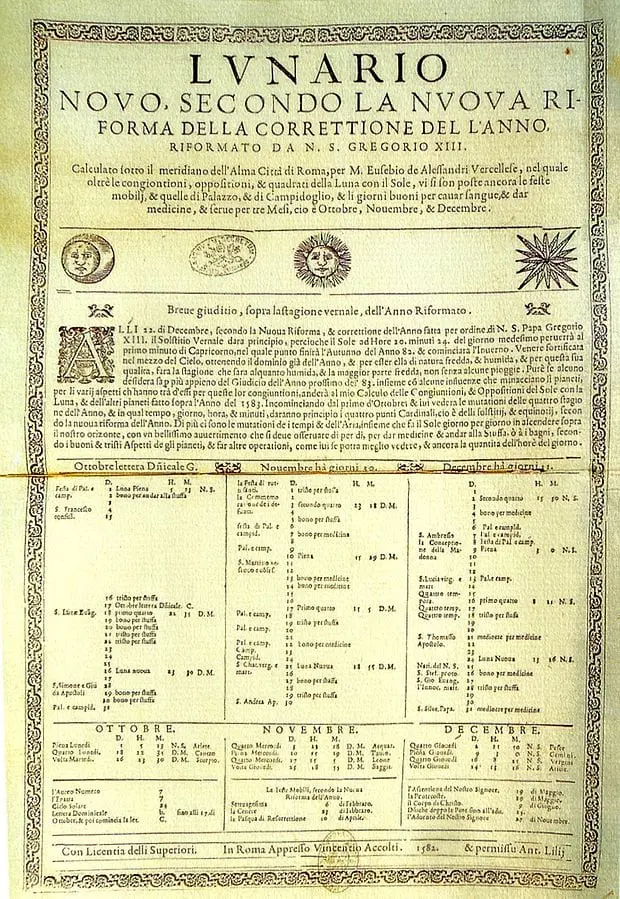
After years of meticulous study and consultation, Pope Gregory XIII was ready to act. On February 24, 1582, he issued a papal bull titled “Inter Gravissimas.” This decree officially proclaimed the new calendar. It commanded its immediate adoption throughout the Catholic world.
The bull outlined the necessary changes. It also explained the astronomical and religious rationale behind them. This official pronouncement marked the birth of the Gregorian Calendar history as we know it today. It set the stage for a dramatic shift in global timekeeping.
The Revolutionary Leap Year Rule
The core innovation of the Gregorian Calendar lay in its refined leap year rule. The Julian Calendar’s rule of adding a leap day every four years was too generous. It led to the 11-minute annual discrepancy.
The Gregorian reform introduced a more nuanced approach. A year is a leap year if it is divisible by 4, *unless* it is a century year. Century years (like 1700, 1800, 1900) are only leap years if they are divisible by 400. This means 1600 and 2000 were leap years, but 1700, 1800, and 1900 were not.
This subtle adjustment dramatically increased the calendar’s accuracy. It brought the average year length to 365.2425 days. This is exceptionally close to the true tropical year. It effectively corrected the vernale equinox correction issue. This ensured that the calendar remained aligned with astronomical reality for centuries to come.
The Great Calendar Jump of 1582
The implementation of the new calendar required more than just a new rule. It also demanded a correction for the accumulated error. By 1582, the Julian Calendar was approximately ten days ahead of the true solar year. This meant ten days had to be removed from the calendar.
A Moment in Time Lost
Pope Gregory XIII’s bull stipulated a precise and dramatic change. In October 1582, ten days were simply skipped. Thursday, October 4, 1582, was immediately followed by Friday, October 15, 1582.
Imagine the confusion and disruption this caused! People went to bed on October 4th and woke up to find it October 15th. This unprecedented jump aimed to realign the calendar. It brought the vernal equinox back to its traditional date around March 21.

This event is a unique moment in the history of the Gregorian Calendar and May Month. It represents a deliberate, widespread alteration of recorded time. Historical accounts note varying reactions, from compliance to outright protest, as societies grappled with the sudden change.
Initial Resistance and Gradual Adoption
The adoption of the Gregorian Calendar was not instantaneous or universal. Catholic countries, primarily in Italy, Spain, Portugal, and parts of France, quickly embraced the new system. However, Protestant countries viewed the reform with suspicion. They saw it as a Catholic imposition. They resisted adopting a calendar mandated by the Pope.
For over a century, Europe operated under two different calendars. This created significant challenges for international communication, trade, and diplomacy. Dates for events would be different depending on whether a country used the ‘Old Style’ (Julian) or ‘New Style’ (Gregorian) calendar. The Julian vs Gregorian Calendar differences became a major point of discussion and sometimes contention across the continent.
The Global Spread: From Europe to the World
Despite initial resistance, the superior accuracy of the Gregorian Calendar eventually won out. The need for a standardized, globally recognized system for timekeeping became increasingly apparent.
Challenges and Acceptance Across Nations
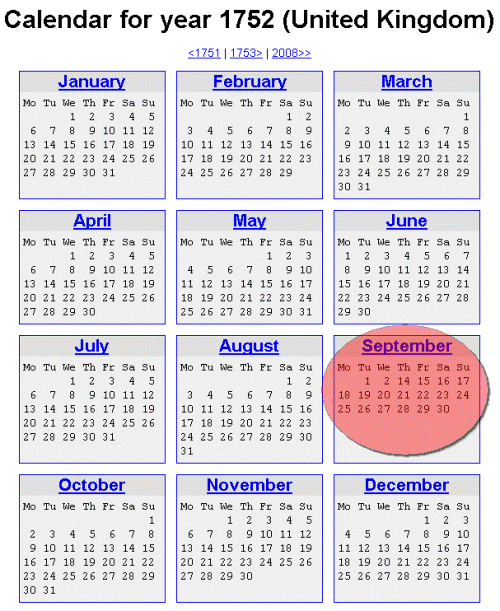
Protestant states gradually adopted the Gregorian Calendar. Germany and the Netherlands adopted it in the early 18th century. Great Britain and its colonies, including what would become the United States, made the switch in 1752. They famously had to drop 11 days, from September 2 to September 14. This change was met with some public unrest, with shouts of “Give us back our eleven days!”
Eastern Orthodox countries were even slower to adopt. Russia did not implement the Gregorian Calendar until after the 1917 October Revolution. They famously skipped 13 days in 1918. Many Orthodox churches still follow the Julian Calendar for their religious observances, leading to different dates for holidays like Christmas and Easter compared to Western churches.
The Enduring Legacy
Today, the Gregorian Calendar is the most widely used civil calendar in the world. Its nearly universal adoption underscores its precision and practicality. It facilitates global commerce, scientific research, and international relations. Its establishment represents a triumph of scientific inquiry and international collaboration, even amidst religious and political divisions.
The calendar’s journey from a Roman mess to a global standard is a testament to humanity’s ongoing quest for order and understanding of the cosmos. It reminds us that even the most seemingly simple aspects of our daily lives have a rich and complex calendar evolution behind them.
Unveiling May: The Story Behind the Fifth Month
As we navigate the fascinating history of the Gregorian Calendar and May Month, it’s fitting to explore the origins of this particular month. May evokes images of spring, blooming flowers, and renewed life. But where did its name come from? Like much of our calendar, its roots lie in the traditions of ancient Rome.
From Ancient Rome to Modern Times
The May month history is deeply intertwined with ancient Roman mythology and agricultural practices. The Romans had a profound respect for nature and the deities associated with it. They named many months after gods, goddesses, or significant events. This practice reflects their worldview and the seasonal rhythms that governed their lives.
Maia and Flora: Goddesses of Growth
The most widely accepted origin for the name ‘May’ is from Maia, a Roman goddess of fertility, growth, and spring. She was often associated with volcanic fire (being linked to Vulcan) and nurturing growth. Her festival, the Maiuma, was celebrated in ancient Rome. This celebrated the flourishing of vegetation and the burgeoning life of spring. She was seen as a nurturer, embodying the earth’s awakening after winter.
Another Roman goddess often associated with May is Flora. She was the goddess of flowers and spring. Her festival, the Floralia, also took place during this month. While Maia is the primary namesake, Flora’s presence further solidifies May’s connection to blooming nature and joyous celebrations of life.
In the earliest Roman calendar, before January and February were added, May was the third month. When the calendar was reformed and expanded, it became the fifth month. Its association with new beginnings and abundance remained unwavering, transitioning smoothly into the Julian and then the Gregorian systems.
Cultural Celebrations and Significance
Across various cultures, May has retained its significance as a month of celebration and new life. May Day celebrations are widespread. These often include traditions like dancing around a maypole, crowning a May Queen, and parades. These festivities typically welcome spring and celebrate fertility and rebirth.
In many parts of the world, May also marks significant labor and workers’ rights observances. International Workers’ Day (May 1st) is celebrated in numerous countries. This cultural significance shows how ancient roots can evolve into modern observances. The month continues to hold a special place in the global calendar, symbolizing renewal and vibrant activity.
| Feature | Julian Calendar (Introduced 45 BC) | Gregorian Calendar (Introduced 1582 AD) |
|---|---|---|
| Average Year Length | 365.25 days | 365.2425 days |
| Leap Year Rule | Every 4 years | Every 4 years, EXCEPT century years not divisible by 400 |
| Accumulated Error (by 1582) | ~10 days ahead of the solar year | Corrected error by skipping 10 days |
| Vernal Equinox | Drifting earlier in the calendar year | Stabilized around March 20/21 |
| Primary Motivator for Reform | Bringing order to chaotic Roman calendars | Correcting astronomical drift for Easter calculations |
| Modern Usage | Primarily for historical research or some Eastern Orthodox churches | Widely adopted as the international civil standard |
The journey through the history of the Gregorian Calendar and May Month is a vivid reminder of how deeply intertwined human culture, religion, and scientific advancement are. From ancient Roman festivals to papal decrees, the quest for accurate timekeeping has shaped our world in profound ways. The next time you glance at a date, remember the millennia of effort behind that simple numerical display.
Frequently Asked Questions
Why was the Gregorian Calendar reform necessary?
The reform was crucial because the preceding Julian Calendar, while a significant improvement, had a slight inaccuracy: its average year length was about 11 minutes too long. Over centuries, this caused the calendar to drift out of sync with astronomical events, most notably the vernal equinox, which impacted the calculation of Easter and other Christian holidays.
What was the main difference between the Julian and Gregorian Calendar’s leap year rules?
The Julian Calendar had a simple rule: a leap day was added every four years. The Gregorian Calendar refined this by adding an exception: century years (like 1700, 1800, 1900) are only leap years if they are divisible by 400. This adjustment makes the Gregorian year much closer to the true tropical year.
How did the 1582 calendar reform affect daily life?
In countries that adopted the reform in 1582, ten days were skipped: October 4th was immediately followed by October 15th. This caused significant disruption and confusion, affecting rent payments, birthdays, and other timed events. Over time, societies adjusted to the new system, which brought greater accuracy to timekeeping.
What is the origin of the name for the month of May?
The month of May derives its name from the Roman goddess Maia. She was associated with fertility, growth, and spring, symbolizing the flourishing of vegetation and new life. Her festivals celebrated the abundance of nature, making her a fitting namesake for this vibrant spring month.