As an avid skywatcher and astronomy enthusiast, few things spark my excitement quite like the promise of a celestial display. There’s something truly magical about stepping out under a dark sky, looking up, and witnessing nature’s own fireworks show. For those of us eagerly anticipating our next cosmic experience, the July 2026 meteor shower predictions offer some truly exciting prospects. This summer is shaping up to be a fantastic opportunity for stargazers, especially given the favorable lunar conditions we’re expecting.
Get ready to mark your calendars and prepare your viewing spots, because July 2026 promises a duo of active meteor showers, the Southern Delta Aquariids and the Alpha Capricornids, with the moon playing a benevolent role. Let’s dive deep into what makes these events so special and how you can make the most of the July 2026 meteor shower predictions.
Understanding July’s Celestial Fireworks: The Main Players
July is a fascinating month for meteor showers, typically dominated by two consistent performers. These aren’t the mighty Perseids of August, but they offer their own unique charm, often producing faint, wispy trails or, in the case of the Alpha Capricornids, the occasional brilliant fireball.
The Southern Delta Aquariids: A Summer Classic
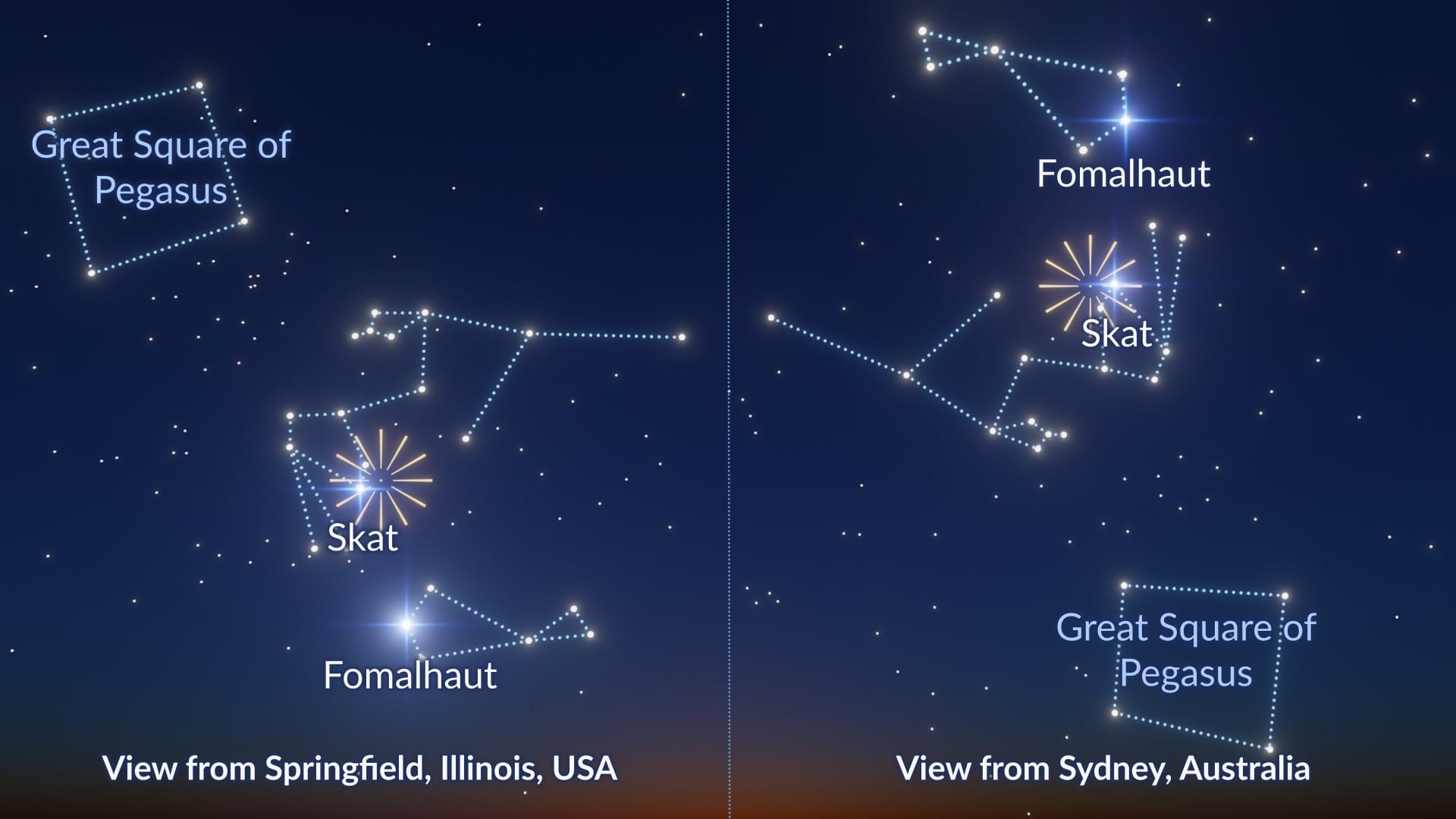
The Southern Delta Aquariids are arguably the most prominent meteor shower of July. They get their name because their radiant, the point from which they appear to emanate, lies within the constellation Aquarius. This shower is active for a considerable period, but its peak is typically in late July.
For July 2026 meteor shower predictions, we’re looking at a peak around the night of July 28th into the morning of July 29th. This timing is particularly fortuitous because the New Moon occurs on July 24th, 2026. This means minimal lunar interference during the peak nights, leading to wonderfully dark skies for observation. The Zenithal Hourly Rate (ZHR) for the Southern Delta Aquariids is modest, typically around 15-20 meteors per hour under ideal conditions. While not a deluge, these meteors are often faint and swift, requiring patience and dark-adapted eyes.
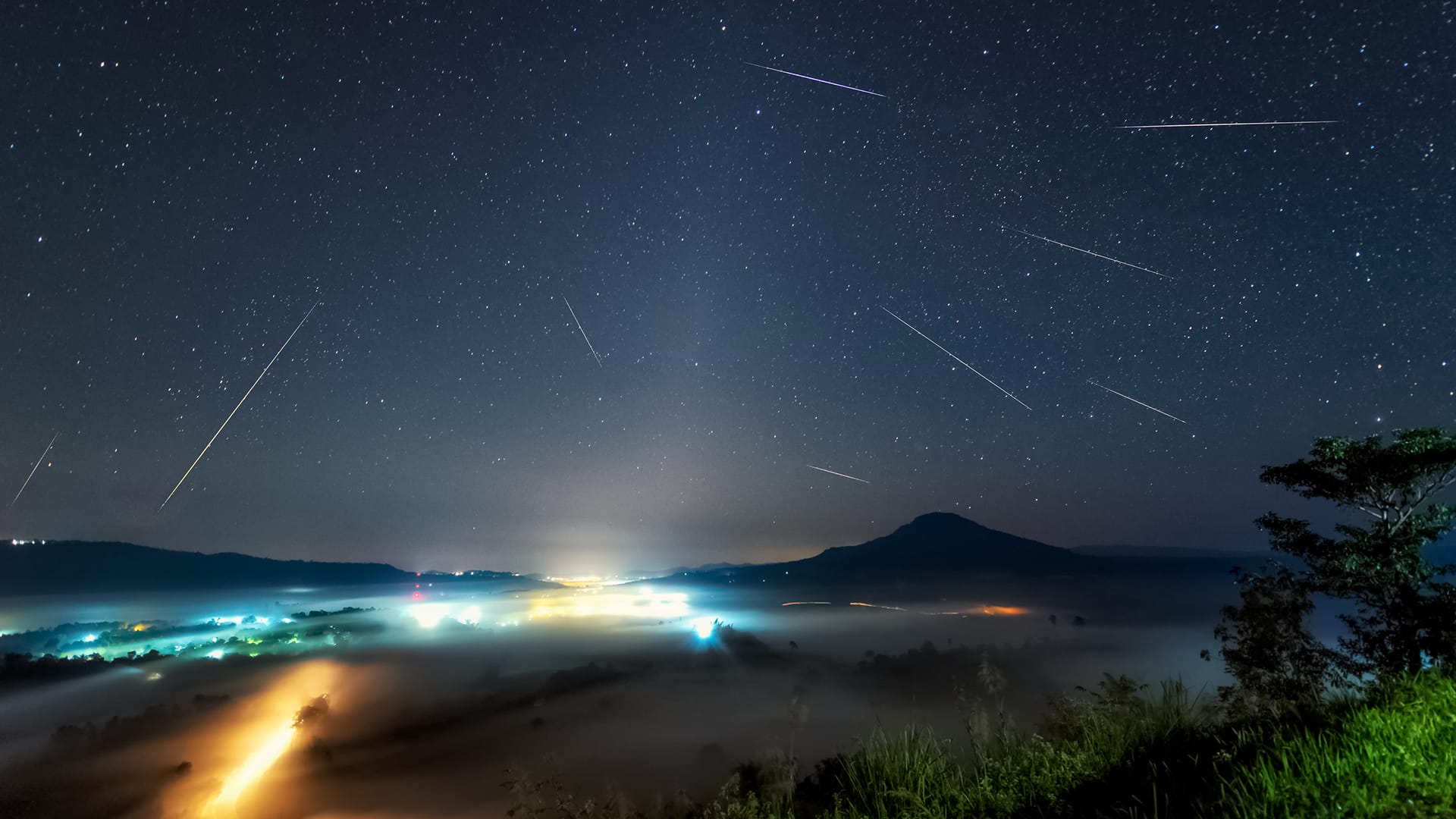
These meteors originate from debris left behind by Comet 96P/Machholz. As Earth passes through this stream of dusty particles, they collide with our atmosphere at high speeds, ablating and creating those fleeting streaks of light we call shooting stars. They are best viewed from the Southern Hemisphere, but observers in the Northern Hemisphere, especially those at mid-latitudes, can still enjoy a good show, though the radiant will be lower in the sky.
The Alpha Capricornids: Fireball Specialists
While often less numerous than the Delta Aquariids, the Alpha Capricornids have a reputation for producing bright, slow-moving fireballs. These spectacular events can light up the entire sky, leaving lingering trails that mesmerize onlookers. Their radiant is in the constellation Capricornus.
The Alpha Capricornids also peak around late July and early August, overlapping significantly with the Southern Delta Aquariids. For July 2026 meteor shower predictions, their activity will also be strong around the July 28th-29th window, benefiting from the same dark sky conditions. The ZHR for the Alpha Capricornids is quite low, often just 5 meteors per hour, but the quality of these meteors often makes up for their scarcity. It’s always exciting to scan the sky and wonder if the next streak will be one of these luminous giants.
The parent body for the Alpha Capricornids is believed to be the comet 169P/NEAT. These meteors are known for their distinctive yellowish-orange hue and can break up into fragments, creating multiple glowing pieces in their descent.
The Favorable Lunar Conditions of July 2026
When it comes to observing meteor showers, the moon’s phase is often the most critical factor. A bright moon can easily wash out all but the brightest meteors, turning a potentially stunning display into a faint, disappointing one. This is why the July 2026 meteor shower predictions are particularly exciting.
The New Moon falls on July 24th, 2026. This means that from approximately July 22nd through July 27th, and especially during the peak nights of the Southern Delta Aquariids and Alpha Capricornids (July 28th-29th), the moon will be a thin crescent or completely absent from the night sky. This provides optimal dark-sky conditions, allowing even fainter meteors to be visible, dramatically increasing the potential for a memorable experience.
Maximizing Your Meteor Shower Viewing Experience in July 2026
To truly appreciate the July 2026 meteor shower predictions, a little preparation goes a long way. As an experienced stargazer, I’ve learned that comfort and patience are your best friends when chasing shooting stars.
Finding Your Perfect Viewing Spot
The single most important factor is escaping light pollution. City lights create a pervasive glow that outshines faint celestial objects. Ideally, you want to find a location with a Bortle Scale rating of 3 or lower. This means rural areas, national parks, or designated dark sky preserves.
- Go rural: Drive away from towns and cities. The darker, the better.
- Look up: Ensure there are no tall buildings or trees directly obscuring your view of the sky, especially towards the south for the Delta Aquariids.
- Safety first: Always inform someone of your plans, especially if you’re venturing to a remote location.
Timing is Everything
Meteor showers are generally best viewed after midnight, once the radiant is higher in the sky, and leading up to the pre-dawn hours. This is because at this time, your location on Earth is facing directly into the meteoroid stream, much like the windshield of a car gathering bugs. For the July 2026 meteor shower predictions, plan to start your viewing session around 11 PM or midnight local time on the peak nights, continuing until the first hints of dawn.
Comfort and Preparedness
Stargazing requires patience, and sitting or lying still for extended periods can get chilly, even in July. Here’s my essential kit:
- Reclining chair or blanket: Lie flat on your back for the widest view.
- Warm layers: Even on a summer night, temperatures can drop.
- Bug spray: Especially important in rural areas during summer.
- Snacks and drinks: Stay hydrated and energized.
- Red-light flashlight: Preserves your night vision. White light ruins it.
Dark Adaptation and Patience
Your eyes need time to adjust to the darkness. Allow at least 20-30 minutes for your pupils to fully dilate. During this time, avoid looking at any bright screens or lights. Once adapted, your eyes become incredibly sensitive to faint light, revealing many more meteors. Meteor showers aren’t constant streams; they come in bursts and lulls. Be patient, relax, and enjoy the experience. Just keep scanning the sky with your naked eye – no binoculars or telescopes needed for meteors!
The Science Behind the Spectacle: What Are You Actually Seeing?
While enjoying the beauty, it’s fascinating to understand the science behind these cosmic encounters. The July 2026 meteor shower predictions are more than just pretty lights; they’re a direct connection to the solar system’s history.
Cometary Debris and Earth’s Orbit
Meteor showers occur when Earth passes through a stream of debris left behind by a comet or, less commonly, an asteroid. As comets orbit the Sun, they release ice, dust, and rock particles, forming a dusty trail along their path. When Earth intersects this trail, these tiny particles, ranging from grains of sand to pebble-sized objects, slam into our atmosphere.
The Fiery Entry
Upon entering Earth’s atmosphere at speeds of tens of thousands of miles per hour, these meteoroids (the term for space rocks before they hit the atmosphere) compress the air in front of them. This compression superheats the air, causing the meteoroid itself to ablate and glow brightly. This luminous trail is what we see as a meteor or a “shooting star.” Most meteoroids burn up completely high in the atmosphere, never reaching the ground.
The Radiant Explained
All meteors from a particular shower appear to originate from a single point in the sky, known as the radiant. This is an effect of perspective, similar to how parallel train tracks seem to converge in the distance. The radiant’s location helps astronomers identify which shower a meteor belongs to. For the Delta Aquariids, this point is in Aquarius; for the Alpha Capricornids, it’s in Capricornus.
A Look at the July 2026 Meteor Shower Calendar
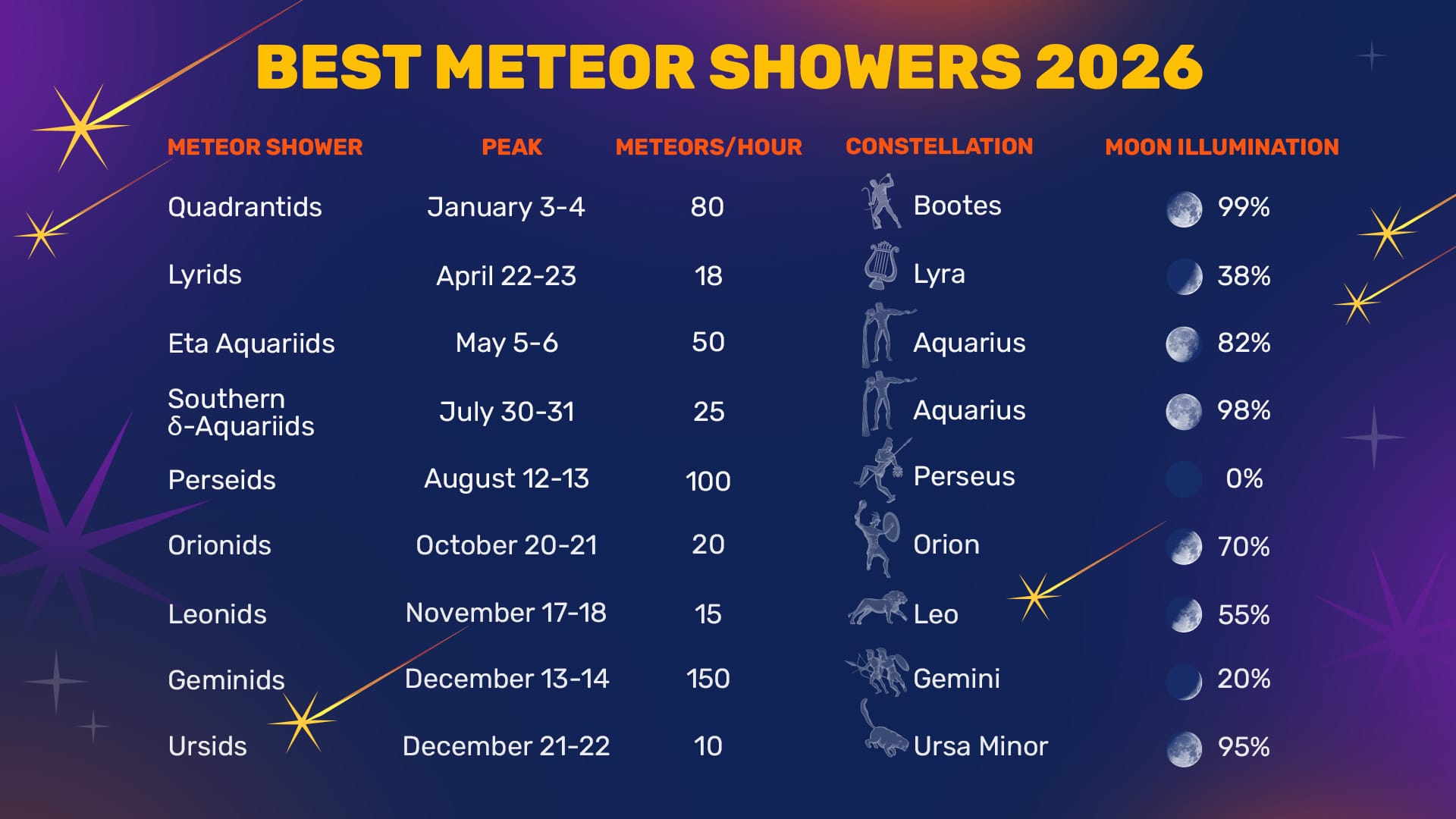
To help you plan your skywatching adventures, here’s a summary of the expected activity for July 2026 meteor shower predictions:
| Date (Night of) | Meteor Shower | Peak Activity | ZHR (Approx.) | Lunar Phase | Expected Visibility |
|---|---|---|---|---|---|
| July 1 – July 20 | Minor Activity | Low | 0-5 | Waning Gibbous to Waxing Crescent | Sporadic meteors possible. |
| July 24 | N/A | New Moon | N/A | New Moon (Excellent Dark Skies) | Ideal conditions for upcoming showers. |
| July 27 – 28 | Southern Delta Aquariids | Pre-Peak | 5-10 | Waxing Crescent | Good, increasing activity. |
| July 28 – 29 | Southern Delta Aquariids | Peak Night | 15-20 | Waxing Crescent (Very Low) | Excellent viewing conditions. |
| July 28 – 29 | Alpha Capricornids | Peak Night | 5 (Fireballs possible) | Waxing Crescent (Very Low) | Excellent for bright meteors. |
| July 29 – 31 | Southern Delta Aquariids / Alpha Capricornids | Post-Peak | Declining | Waxing Crescent | Still active, good chance of seeing some. |
Remember that ZHR values are theoretical maximums under perfect conditions. Actual observed rates can be lower due to factors like your location, local light pollution, and atmospheric transparency.
Beyond the Show: Contributing to Citizen Science
For those truly passionate about the night sky, observing meteor showers can be more than just a personal enjoyment; it can also contribute to scientific research. Organizations like the International Meteor Organization (IMO) rely on amateur observations to track meteor shower activity, identify new streams, and better understand the dynamics of our solar system.
How You Can Help
If you’re out observing for an extended period, consider recording your observations. Note down the time you start and end, the number of meteors you see, their brightness, and any notable characteristics (like color or persistence of trails). This data, especially from multiple observers around the globe, helps astronomers refine their July 2026 meteor shower predictions and our overall understanding of these fascinating events.
Final Thoughts on Your July 2026 Meteor Shower Adventure
The July 2026 meteor shower predictions point to a genuinely promising period for stargazers. With the Southern Delta Aquariids and Alpha Capricornids peaking under the welcoming cloak of a nearly new moon, conditions are aligning for a spectacular display. Whether you’re a seasoned astronomer or a curious newcomer, these summer nights offer a wonderful opportunity to connect with the cosmos.
So, gather your blankets, find your darkest spot, and prepare for a truly memorable celestial experience. There’s a quiet wonder in watching shooting stars streak across the inky canvas of night. Each meteor is a tiny piece of ancient cosmic history, burning brightly for a fleeting moment before disappearing, leaving us with awe and a refreshed perspective on our place in the universe. Enjoy the show!