As an avid skywatcher and someone deeply fascinated by the intricate dance of our celestial neighbor, I always look forward to planning my observations around the lunar cycle. There’s a unique rhythm to the moon’s journey across the sky, and understanding its phases can unlock a whole new dimension of skywatching, astronomy, and even personal planning. Today, we’re diving into the specifics of the Moon Phases September 2026 Calendar, a crucial guide for anyone looking to connect with the cosmos.
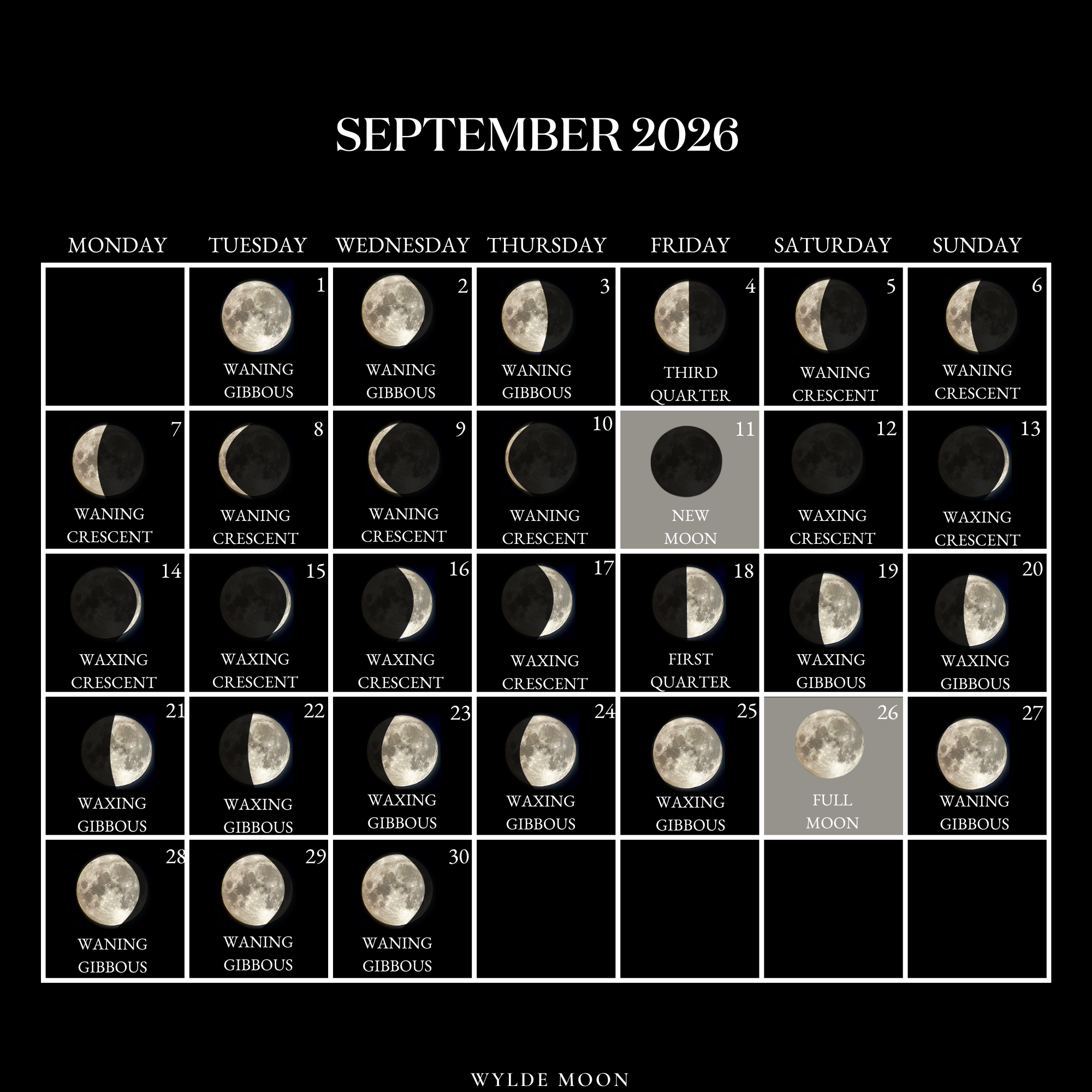
September 2026 promises a captivating display of lunar beauty, offering numerous opportunities for both casual observers and dedicated astronomy enthusiasts. Whether you’re planning moon photography sessions, aligning your gardening schedule, or simply seeking moments of quiet reflection, knowing the exact lunar cycle dates is incredibly beneficial. Join me as we explore every significant lunar moment this September.
Understanding the Lunar Cycle: A Cosmic Ballet
Before we pinpoint the specific dates for the Moon Phases September 2026 Calendar, let’s quickly recap what moon phases are. The moon itself doesn’t change shape; what we perceive as different phases is merely the varying amount of its sunlit surface visible from Earth. This ever-changing appearance is a direct result of the moon’s orbital position relative to the Earth and the Sun.
Our moon completes an orbit around Earth approximately every 27.3 days, but it takes about 29.5 days for it to complete a full lunar cycle from one New Moon to the next. This difference is because the Earth is also orbiting the Sun, so the moon has to travel a bit further to get back to the same alignment with the Sun and Earth. This synodic period is what we commonly refer to when discussing the lunar calendar.
Throughout this cycle, we witness eight distinct phases:
- New Moon: The moon is not visible as its sunlit side faces away from Earth. This is the perfect time for dark sky observations of distant galaxies and nebulae.
- Waxing Crescent: A sliver of light appears on the right side (in the Northern Hemisphere) as the moon begins to grow.
- First Quarter: Half of the moon is illuminated, appearing as a perfect ‘D’ shape. It rises around noon and sets around midnight.
- Waxing Gibbous: More than half, but not yet full, of the moon is illuminated.
- Full Moon: The entire face of the moon is illuminated, appearing as a bright, complete disc.
- Waning Gibbous: The illumination begins to decrease after the Full Moon.
- Last Quarter: Again, half of the moon is illuminated, but this time the left side (in the Northern Hemisphere) is lit. It rises around midnight and sets around noon.
- Waning Crescent: A final sliver of light remains before the moon becomes new again.
Each of these phases holds unique appeal and significance, whether for astronomy, stargazing, or cultural practices.

The September 2026 Lunar Journey: A Detailed Look
September 2026 presents a fantastic opportunity to observe the lunar cycle in its entirety. From the optimal conditions for dark sky deep-space skywatching during the New Moon to the breathtaking illumination of the Full Moon, there’s something for everyone. Let’s mark our calendars for these key celestial events.
New Moon: September 22, 2026
The New Moon on September 22, 2026, at approximately 08:31 UTC (Coordinated Universal Time), marks the beginning of a new lunar cycle. During this phase, the moon is positioned between the Earth and the Sun, making its sunlit side face away from us. From our perspective on Earth, the moon is essentially invisible, blending into the darkened sky.
For astronomy enthusiasts, the New Moon is a highly anticipated event. With the moon’s brilliant light absent, the night sky becomes significantly darker, offering unparalleled conditions for viewing faint objects like galaxies, nebulae, and star clusters. If you have a telescope or binoculars, this is your prime opportunity for deep-sky stargazing and perhaps even some serious astrophotography without lunar interference.
First Quarter Moon: September 30, 2026
Just over a week after the New Moon, we’ll experience the First Quarter Moon on September 30, 2026, around 02:45 UTC. At this point, the moon has completed approximately a quarter of its orbit around Earth since the New Moon. From the Northern Hemisphere, it appears as a perfectly half-illuminated disk, with the right side brightly lit. This phase is often visible high in the sky during the afternoon and early evening.
The First Quarter Moon is an excellent target for casual skywatching. The terminator line – the boundary between the illuminated and dark parts of the moon – is especially striking. Along this line, shadows cast by craters and mountains are elongated, revealing incredible lunar topography with stark clarity. A small telescope or even binoculars will provide stunning views of these lunar features, enhancing your understanding of our moon’s rugged surface.

Full Moon: September 7, 2026
The Full Moon arrives early in the month, gracing our skies on September 7, 2026, at approximately 12:47 UTC. This is when the moon is on the opposite side of the Earth from the Sun, allowing its entire face to be bathed in sunlight and fully visible to us. The September Full Moon is traditionally known as the Harvest Moon in the Northern Hemisphere, a name derived from its brilliant light that historically aided farmers working late to gather summer crops.
The Harvest Moon is a spectacular sight, dominating the night sky with its bright illumination. While its brightness can make deep-sky stargazing challenging, it’s a prime target for lunar observation itself. Its bright glow is perfect for moon photography, even with basic camera equipment. Many also find the Full Moon to be a powerful time for personal reflection, meditation, and engaging with various spiritual practices linked to lunar cycles. Its visual majesty reminds us of the constant and beautiful celestial mechanics governing our solar system.
Last Quarter Moon: September 15, 2026
Mid-month brings the Last Quarter Moon on September 15, 2026, around 17:33 UTC. Similar to the First Quarter, half of the moon is illuminated, but this time it’s the left side (for Northern Hemisphere observers). This phase rises around midnight and is visible throughout the morning sky, often lingering past sunrise.
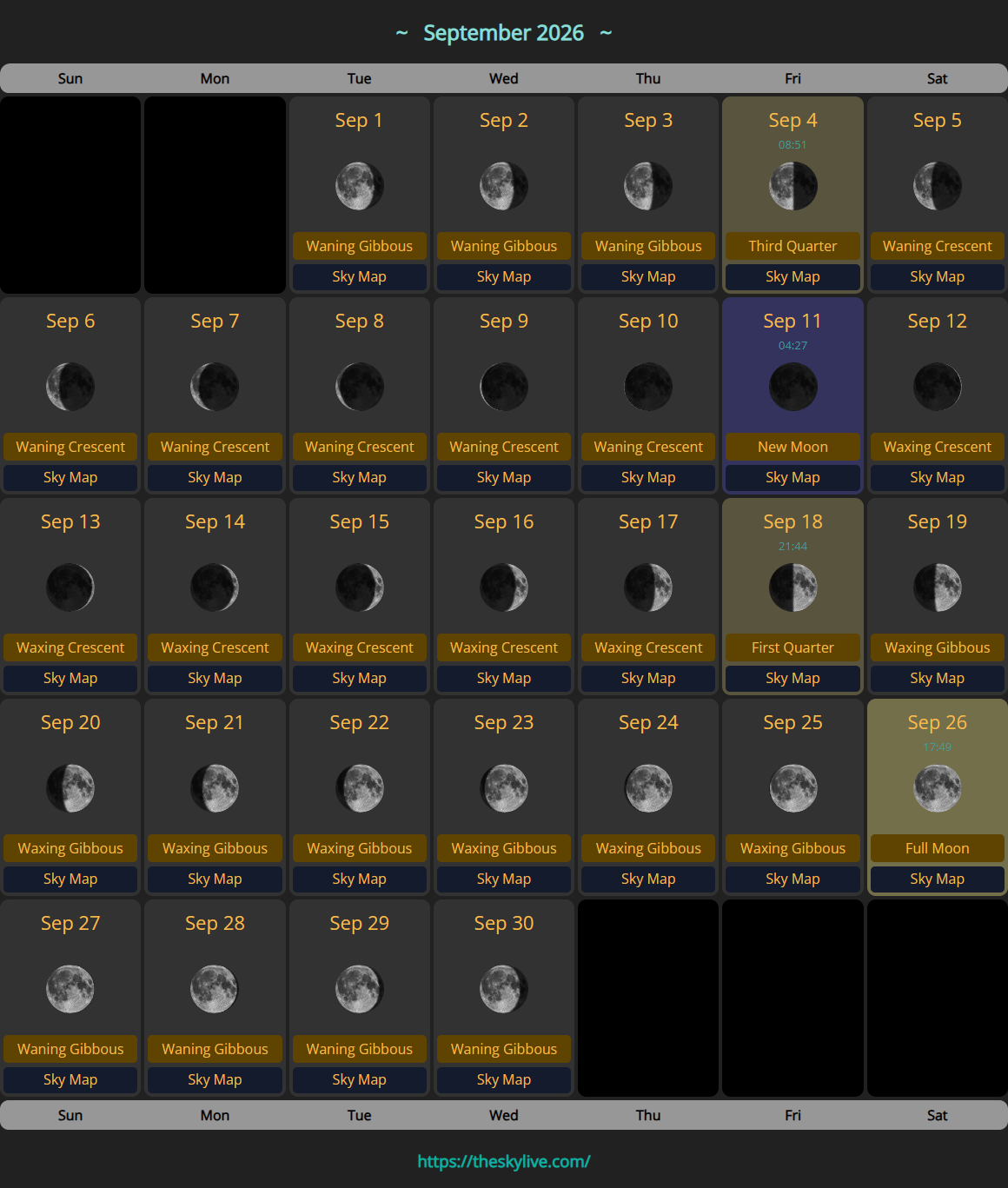
Observing the Last Quarter Moon offers another opportunity to appreciate the moon’s rugged terrain, particularly the features along its new terminator line. For early risers, catching the moon as it descends in the morning sky can be a peaceful and rewarding experience. This phase also marks the waning period, leading us back towards the obscurity of the New Moon, preparing the stage for another round of dark sky deep-space observations.
Moon Phases September 2026 Calendar: Your Quick Reference
To help you plan your skywatching and activities, here’s a detailed table outlining the major Moon Phases September 2026 Calendar events. All times are approximate and in Coordinated Universal Time (UTC).

| Phase | Date (2026) | Time (UTC) | Approx. Illumination | Key Characteristics |
|---|---|---|---|---|
| Full Moon (Harvest Moon) | September 7 | 12:47 | 100% | Brightest illumination, excellent for photography, traditional Harvest Moon. |
| Last Quarter Moon | September 15 | 17:33 | 50% | Half-illuminated (left side), visible in morning sky, ideal for crater observation. |
| New Moon | September 22 | 08:31 | 0% | Invisible, optimal for dark sky deep-space stargazing. |
| First Quarter Moon | September 30 | 02:45 | 50% | Half-illuminated (right side), visible in evening sky, great for lunar surface details. |
Other Notable Lunar Events and Observations in September 2026
Beyond the primary phases, the changing illumination of the moon throughout September offers continuous opportunities for observation. The waxing crescent and waxing gibbous phases after the New Moon, and the waning gibbous and waning crescent phases after the Full Moon, each have their own unique charm. These intermediate phases are often beautiful targets for casual viewing and can be quite photogenic as they transit the evening or morning skies.
Keep an eye out for conjunctions as well. The moon often passes close to bright planets or prominent stars, creating beautiful celestial pairings. While not a primary focus of the Moon Phases September 2026 Calendar, these transient celestial events add another layer of excitement to your skywatching experience.
Why Track Moon Phases? Beyond Basic Skywatching
Understanding the lunar cycle and consulting the Moon Phases September 2026 Calendar is beneficial for a myriad of activities, far beyond just admiring the night sky. My own experience has shown me how intimately connected our lives are to these celestial mechanics.
For Astronomy and Astrophotography Enthusiasts
As mentioned, the New Moon is paramount for deep-sky astronomy. Without the moon’s bright glow, faint galaxies, nebulae, and star clusters become significantly easier to observe and photograph. Conversely, the Full Moon and bright quarter phases are ideal for lunar astrophotography, allowing you to capture intricate details of craters, maria, and mountain ranges.
Knowing when the moon will be bright or dark allows you to plan your stargazing sessions accordingly. Are you aiming to find that elusive faint galaxy? Target the week around the New Moon. Do you want to capture a stunning close-up of the lunar surface? The days around the quarter moons offer excellent contrast along the terminator line, while the Full Moon provides maximum illumination for wide-field shots.
Gardening and Agriculture: Planting by the Moon
Many traditional gardening practices, known as gardening by the moon, advocate for planting and harvesting according to the lunar phases. The belief is that the moon’s gravitational pull influences moisture in the soil, affecting seed germination and plant growth. During the waxing moon (from New Moon to Full Moon), when light and gravitational pull are increasing, it’s considered an ideal time for planting above-ground crops, such as leafy greens and fruits.
Conversely, during the waning moon (from Full Moon to New Moon), when the moon’s light and gravitational pull are decreasing, it’s thought to be best for planting root crops, pruning, and harvesting. While scientific consensus on this practice varies, many gardeners swear by it, finding it aligns them more closely with natural rhythms. Consulting the Moon Phases September 2026 Calendar can help you experiment with these ancient techniques in your own garden.
Fishing and Tides: Lunar Influence
The moon’s gravitational pull is the primary driver of ocean tides. High tides occur roughly twice a day, coinciding with the moon’s overhead position and its opposite side. During the New Moon and Full Moon (when the Sun, Earth, and Moon are aligned), the gravitational forces combine, resulting in stronger ‘spring tides’ with higher highs and lower lows. During the First Quarter and Last Quarter moons (when the Sun and Moon are at right angles to Earth), the gravitational forces work against each other, producing weaker ‘neap tides’.
Fishermen often observe that fishing success can be influenced by these tidal changes. Stronger tides during spring moons can mean more active fish feeding. Knowing the lunar phase from your lunar calendar can give you an edge in planning your fishing trips, allowing you to anticipate optimal conditions and potentially more fruitful catches.
Personal Well-being and Spiritual Practices
Throughout history and across cultures, the moon has held profound symbolic and spiritual significance. The Full Moon is often associated with culmination, release, and heightened energy, making it a popular time for meditation, intention setting, and other spiritual practices. The New Moon, in contrast, is seen as a time for new beginnings, introspection, and planting seeds of intention for the coming cycle.
Many individuals find that tuning into the lunar cycle provides a deeper connection to nature and their own inner rhythms. Tracking the Moon Phases September 2026 Calendar can become a mindful practice, allowing you to align personal goals and reflective moments with the natural ebb and flow of the cosmos, drawing upon ancient lunar lore for personal growth.
Tips for Observing the Moon in September 2026
To make the most of the Moon Phases September 2026 Calendar, here are some practical tips from my own skywatching adventures:
-
Choose Your Equipment Wisely
You don’t need expensive gear to enjoy the moon. Binoculars are fantastic for close-up views, revealing craters and lunar maria even during a bright Full Moon. A modest telescope will provide even more detail. For astrophotography, a standard DSLR or mirrorless camera with a telephoto lens can capture stunning shots, especially with the aid of a tripod.
-
Find a Dark Sky Location for Deep-Sky Observing
For optimal dark sky observations around the New Moon, try to get away from city lights. Light pollution washes out faint celestial objects. Even a short drive to a rural area can make a huge difference in what you can see. Apps and websites can help you locate suitable dark sky sites near you.
-
Check Local Moonrise/Moonset Times
The times provided in our Moon Phases September 2026 Calendar are in UTC. Remember to convert these to your local time zone. Additionally, moonrise and moonset times vary significantly by location and are crucial for planning your observations. Websites like timeanddate.com or apps from organizations like NASA can provide precise local data.
-
Dress for the Weather and Be Patient
Nighttime can get chilly, even in September. Dress in layers, bring a warm drink, and be prepared to be patient. Clouds can roll in unexpectedly, but often clear up. The beauty of skywatching is in the experience, not just the perfect view.
-
Share the Experience
There’s nothing quite like sharing the wonder of the moon with others. Invite friends or family to join you for an evening of stargazing. A shared celestial event is always more memorable, fostering a sense of community and curiosity about space exploration.
Beyond September: Sustaining Your Lunar Journey
The Moon Phases September 2026 Calendar is just one snapshot in the moon’s endless dance. Once you get hooked on tracking its phases, you’ll likely want to continue throughout the year and beyond. Thankfully, resources abound. Reputable astronomical websites, annual almanacs like the Farmer’s Almanac, and dedicated astronomy apps can provide precise lunar calendar data for any given month or year. Organizations like NASA and local astronomical societies often offer public events and educational materials to deepen your knowledge of celestial mechanics and upcoming celestial events.
Embrace the continuous learning that comes with skywatching. Each month brings new perspectives and opportunities to witness the subtle beauty of our closest cosmic neighbor. The moon is a constant, reliable presence, always there to guide our gaze upwards and remind us of the vastness and wonder of the universe.
Conclusion
The Moon Phases September 2026 Calendar is more than just a list of dates; it’s an invitation to connect with the cosmos on a deeper, more personal level. From the vibrant glow of the Harvest Moon to the opportune darkness of the New Moon for deep-sky exploration, September 2026 offers a full spectrum of lunar experiences. Whether you’re an experienced astronomy enthusiast, a budding astrophotography artist, or simply someone who appreciates the quiet majesty of the night sky, understanding these phases enriches your connection to the lunar cycle.
I encourage you to use this Moon Phases September 2026 Calendar as your guide. Step outside, look up, and let the enduring beauty of our moon inspire you. There’s a profound satisfaction in observing these predictable yet always awe-inspiring celestial events. Happy skywatching!
Frequently Asked Questions
What are the key moon phases in September 2026?
In September 2026, the major moon phases include the Full Moon (Harvest Moon) on September 7th, the Last Quarter Moon on September 15th, the New Moon on September 22nd, and the First Quarter Moon on September 30th. These phases mark significant points in the lunar cycle, offering distinct viewing opportunities.
How do moon phases impact daily life or specific activities?
Moon phases can influence various aspects of life. For astronomers, the New Moon provides optimal conditions for deep-sky observation due to minimal lunar illumination. Gardeners may follow lunar calendars for planting and harvesting, while fishermen often consider moon phases and their effect on tides for better catches. Many also use moon phases for spiritual practices and personal reflection.
What’s the best way to observe moon phases?
Observing moon phases can be done with the naked eye, binoculars, or a telescope. For the New Moon, seek a dark sky location away from light pollution to view fainter celestial objects. For other phases, binoculars or a small telescope will reveal intricate details of craters and lunar features. Always check local moonrise and moonset times to plan your observations effectively.
Will there be any unique lunar events in September 2026?
While the primary focus for September 2026 is the regular progression of moon phases, the Full Moon will be notable as the ‘Harvest Moon’, a traditional name signifying its bright illumination aiding late harvests. Additionally, keep an eye out for potential conjunctions where the moon appears close to planets or bright stars, creating beautiful celestial pairings throughout the month.